
History of the Wheelie Bin in Australia
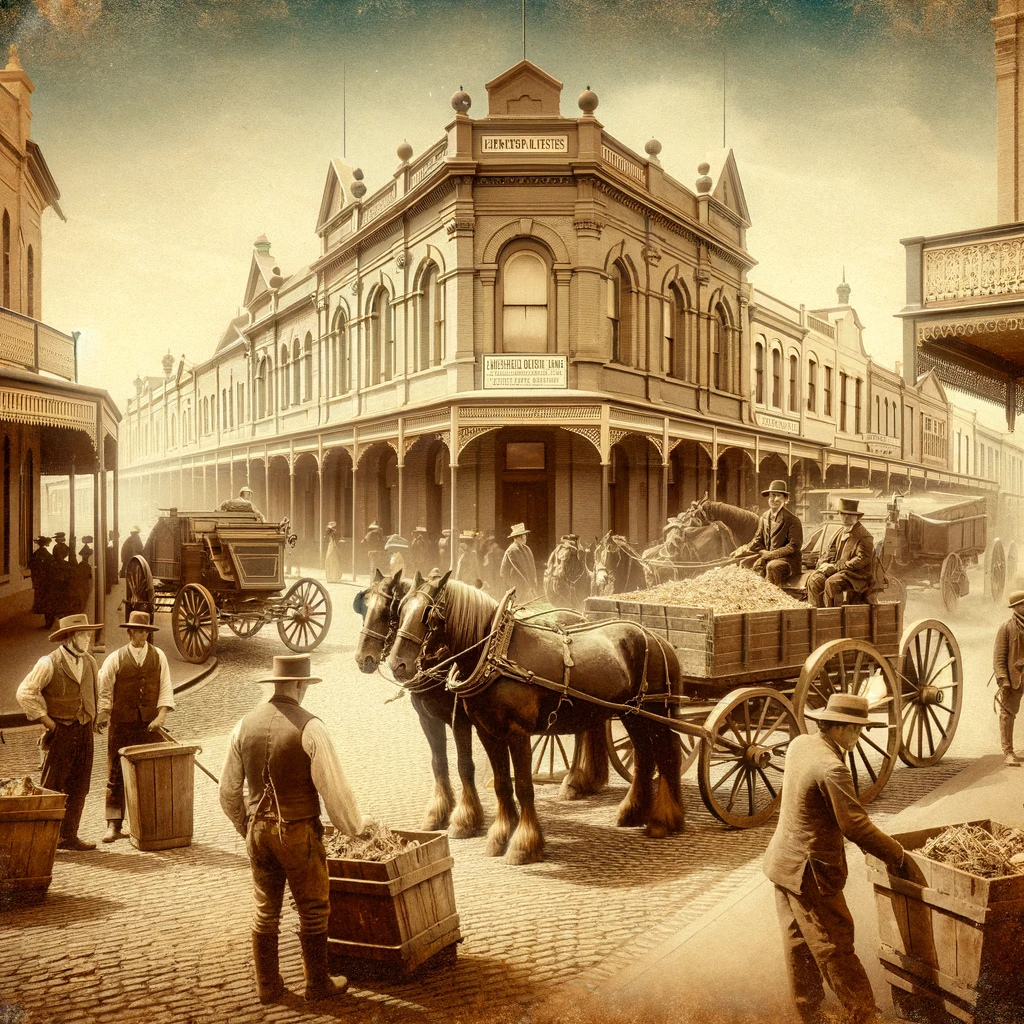
Most people under 40 have never seen the Australian kerbside any other way: a row of wheelie bins lined up on a Tuesday night, lid up or down depending on the week. It was not always like this. The wheelie bin only properly arrived in Australia in the mid-1980s, and the version we know now is a German design from a town called Bremen. This is how it got here, and why it changed kerbside collection for good.
Before the wheelie bin: the galvo era
Through the 1950s, 60s and 70s, Australian kerbside collection ran on the galvanised metal bin: a round, lidded steel can about 55 to 70 litres, built to be lifted by hand. Households put theirs out the night before. The garbo turned up early in the morning, often working in shorts and singlets, grabbed the bin off the kerb, hoisted it up onto his shoulder, walked it back to the truck, and tipped the contents into the hopper.
Two garbos per truck was standard, sometimes three. They ran the route physically, jumping on and off the back of a moving truck between houses. It looked rough and it was rough. Shoulder, back and knee injuries were endemic. The work was so hard that suburban garbos had a reputation as the fittest blokes on any street. They were also among the most injured workers in local government.
The bins themselves were the other half of the problem. Steel rusts. Lids went missing. Dogs and possums got into the unsealed cans overnight. In summer the smell was its own event. Liquid drained out the bottom and pooled on driveways. Compared to what came next, the galvo era was loud, slow and physically brutal on the workforce.
The German design that changed everything
The wheelie bin as we recognise it today comes from Germany, from a company called Otto. The first versions were rolled out in West Germany in the 1970s and early 80s, originally as a 240-litre two-wheel mobile garbage bin (MGB) made from injection-moulded plastic. Otto's design had three features that mattered: it was on wheels, it had an integrated lifting lip that matched a mechanical truck arm, and it had a sealed lid hinged from the back.
Those three features together meant the bin no longer had to be lifted by a human. A hydraulic arm on the truck grabbed the bin by the lip, lifted it up, tipped it into the hopper, and put it back down. One driver, one arm, no manual handling. The bin took itself to the truck, the truck emptied it, the bin went back on the kerb.
The 240L MGB became the European standard. By the early 1980s it was rolling out across West Germany and into the UK and Scandinavia. Then it crossed the equator.
Wollongong, 1986: the first Australian trial
The earliest mass trial of wheelie bins in Australia is generally credited to Wollongong City Council in 1986. The council brought in plastic MGBs from Europe and trialled them on a few suburbs before going citywide. The combination of fewer worker injuries, faster routes, and better presentation on the kerb made the decision obvious.
REMONDIS Australia, then operating as a subsidiary of the same German waste group that helped supply the bins, brought 35,000 wheelie bins in from Germany for a Penrith City Council contract around the same period. Sydney metro councils followed through the late 1980s, with the rest of the country rolling out through the 1990s. By the end of the decade the galvo bin was effectively gone from suburban kerbsides.
From two garbos to one driver
The wheelie bin was not really a bin change. It was a truck change. The bin only worked because the truck on the route was also new: a side-arm loader or rear-loader with a hydraulic lifter. The operator sat in the cab, drove down the street, and at each house an arm reached out, grabbed the bin off the kerb, lifted it up and over, tipped it, and put it back.
Three things changed at once:
- Crew size. Two garbos per truck became one driver. The shoulder-and-back injury rate dropped sharply. The job changed from physical labour to a driving job with hydraulics.
- Route speed. A single-driver mechanised truck could cover more streets per shift than a two-garbo manual crew. Collection days got tighter and councils could run more frequent pickups for the same money.
- Volume per household. A 240L bin holds about three or four times what a galvo can did. Households could go from twice-weekly to weekly collection without anyone running out of space.
The colour-coded lid era
The other thing the wheelie bin made possible was multiple streams. The galvo era effectively had one bin: everything went in, everything went to landfill. With a cheap moulded plastic bin and a truck arm that could grab any bin of the right spec, councils could give every household two bins, three, even four. One for general waste, one for recycling, one for green waste, sometimes one for food organics.
The Australian Standard AS 4123.7 settled the lid colours: red for general waste, yellow for recycling, green or lime for green waste / organics. Most metro councils now run all three. The colour standard means the truck arm and the household behaviour are portable across council boundaries. Anyone moving from Adelaide to Brisbane knows which lid is which.
The private hire side appears
Council kerbside is one thing. The wheelie bin also opened up a second market: private hire bins for commercial and one-off jobs. Bigger sizes (360L, 660L, 1100L) became available because the same injection-moulded design scaled up. A 1100L bin holds about 4 to 5 trailer loads but still rolls on two wheels and fits through a side gate. Businesses started using them for office waste, schools for playground rubbish, cafes for back-of-house bins.
Private bin hire businesses then started offering the same bins on short-term hire for home jobs: deliver a 1100L for a week, you load it, the truck collects. That is the model we run here at Adelaide Wheelie Bins. The bin sits on your property (rolls, fits through a side gate, no permit), you fill it across the week, the truck takes it away. Same wheelie bin the council uses, just bigger and you have got it for 7 days instead of one collection.
Why the wheelie bin stuck
The wheelie bin is not glamorous and it has not really changed in 40 years. The 240L MGB rolling down a driveway in Salisbury in 2026 is recognisably the same design Otto made in West Germany in 1980. That is the point. It works, it is cheap, it stacks neatly on a truck, it pairs with a hydraulic arm, and one driver can run a route that used to need three people.
It also turned out to be unexpectedly flexible. The same shape and lifter spec scaled from 80L all the way up to 1100L without anyone having to reinvent it. That is why private hire works: the truck does not care whether the bin came from the council or from us.
If you are interested in how a wheelie bin stacks up against a skip bin for a one-off job today, the skip bin vs wheelie bin hire in Adelaide comparison goes through it properly: permit rules, footprint, what each one suits.